Tu ne quaesieris (scire nefas) quem mihi, quem tibi finem di dederint, Leuconoe, nec Babylonios temptaris numeros. Vt melius quicquid erit pati! Seu pluris hiemes seu tribuit Iuppiter ultimam, quae nunc oppositis debilitat pumicibus mare Tyrrhenum, sapias, uina liques et spatio breui spem longam reseces. Dum loquimur, fugerit inuida aetas: carpe diem, quam minimum credula postero.
(Original in Latim)
Tu non chiedere - non è concesso sapere - quale fine a me e quale fine a te gli Dèi abbiano concesso, o Leuconoe, e non consultare i calcoli babilonesi. è meglio patire ciò che sarà. sia che Giove ci attribuirà molti inverni O che questo sia l'ultimo, il quale fa infrangere le onde del mar Tirreno sulle opposte scogliere, tu sii saggia e filtra i vini e recidi ogni lunga speranza che oltrepassi il breve spazio del tempo immediato. Mentre parliamo esso è già fuggito. Cogli l'attimo, credendo il meno possibile nel domani (In Dante´s Language)
The current of the flowing river does not cease, and yet the water is not the same water as before. The foam that floats on stagnant pools, now vanishing, now forming, never stays the same for long. So, too, it is with the people and dwellings of the world. (Chambers) Original japonês de 1212
O pote d'o caldo
Y á manta d'a cama.
Venderonll'ó carro
Y as leiras que tina,
Deixarono soyo
C'o á roupa vestida.
—María, eu son mozo,
Pedir non m'é dado,
Eu vou pó-lo mundo
Pra ver de gánalo.
Galicia está probé,
Y á Habana me vou...
¡Adiós, adiós, prendas
D'o meu corazón!
II
Cando ninguen os mira
Vénse rostros nubrados e sombrisos,
Homes qu'erran cal sombras voltejeantes
Por veigas e campíos.
Un, enriva d'un cómaro
Sentase caviloso e pensativo,
Outro, ó pe d'un carballo, queda imóvil
C'o á vista levantada hacia ó infinito.
Algún cabo d'a fronte recinado
Pares qu'escoita atento o murmurio
D'augua que cai, e eisala xordamente
Tristísimos sospiros.
¡Van á deixá-1-a patria!...
Forzoso, mais supremo sacrificio.
A miseria está negra en torno d'eles
¡Ay! ¡y adiant'está o abismo!...
III
O mar castiga bravamente as penas,
E contr'as bandas d'o vapor se rompen
As irritadas ondas
D'o cántabro salobre.
Chilan as gavi
¡Alá lonie!... ¡moy Ionice!
N'a prácida riveira solitaria
Que convida ó descanso y os amores.
De humanos seres á compauta linea
Que brila 6 sol, adiántase e retorcese,
Mais preto, e lentamente as curvas sigue
D'o murallon antigo d'o Parróte.
O corazón apertase d'angustia,
Ovense risas, xuramentos s'oyen,
Y as brasfemias s'a'iuntan c'os sospiros...
¿Onde van eses homes?
Dentro d'un mes n'o simiterio imenso
D'a Habana, ou n'os seus bosques,
Ide á ver que foy d'eles...
¡N'o etern'olvido para sempre dormen!...
¡Probes nais que os criaron,
Y as que os agardan amorosas, probes!
IV
—Animo, compañeiros,
Tod'á térra é d'os homes.
Aquel que non veu nunca mais que a propria
A inorancia ó consomé.
¡ Animo! á quen se muda Dio-l-o axuda!
¡E anqueora vamos de Galicia lonxe,
Veres des que tornemos
O que medrano os robres!
Manan é o dia grande ¡a mar amigos!
¡Manan, Dios nos acoche!
¡N'o sembrante á alegría,
N'o corazón o esforzó
Y acampana armoniosa d'a esperanza,
Lonxe, tocando á morto!
V
Este vaise y aquel vaise
E todos, todos se van,
Galicia, sin homes quedas
Que te poidan traballar.
Tes en cambio orfos e orfas
E campos de soledad,
E nais que non teñen fillos
E fillos que non ten pais.
E tés corazons que sufren
Longas ausencias mortás,
Viudas de vivos e mortos
Que ninguen consolará.
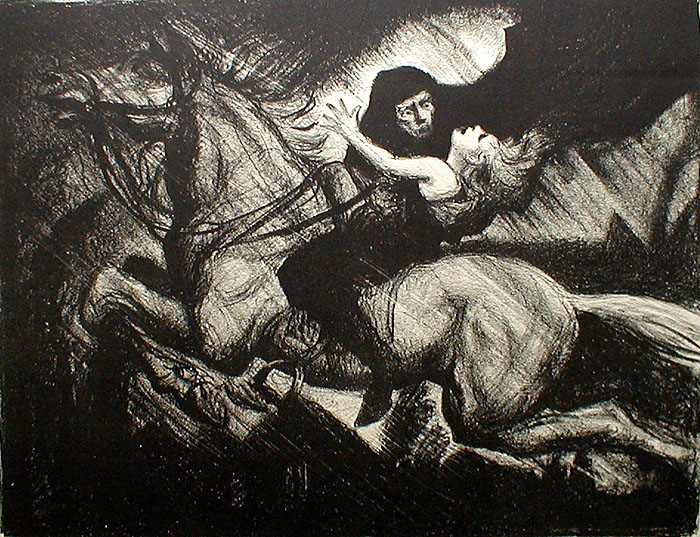
Wer reitet so spät durch Nacht und Wind?
Es ist der Vater mit seinem Kind;
Er hat den Knaben wohl in dem Arm,
Er faßt ihn sicher, er hält ihn warm.
"Mein Sohn, was birgst du so bang dein Gesicht?" –
"Siehst, Vater, du den Erlkönig nicht?
Den Erlenkönig mit Kron und Schweif?" –
"Mein Sohn, es ist ein Nebelstreif."
"Du liebes Kind, komm, geh mit mir!
Gar schöne Spiele spiel' ich mit dir;
Manch' bunte Blumen sind an dem Strand,
Meine Mutter hat manch gülden Gewand." –
"Mein Vater, mein Vater, und hörest du nicht,
Was Erlenkönig mir leise verspricht?" –
"Sei ruhig, bleibe ruhig, mein Kind;
In dürren Blättern säuselt der Wind." –
"Willst, feiner Knabe, du mit mir gehen?
Meine Töchter sollen dich warten schön;
Meine Töchter führen den nächtlichen Reihn,
Und wiegen und tanzen und singen dich ein." –
"Mein Vater, mein Vater, und siehst du nicht dort
Erlkönigs Töchter am düstern Ort?" –
"Mein Sohn, mein Sohn, ich seh es genau:
Es scheinen die alten Weiden so grau. –"
"Ich liebe dich, mich reizt deine schöne Gestalt;
Und bist du nicht willig, so brauch ich Gewalt." –
"Mein Vater, mein Vater, jetzt faßt er mich an!
Erlkönig hat mir ein Leids getan!" –
Dem Vater grauset's, er reitet geschwind,
Er hält in Armen das ächzende Kind,
Erreicht den Hof mit Müh' und Not;
In seinen Armen das Kind war tot.
That's my last Duchess painted on the wall,
Looking as if she were alive. I call
That piece a wonder, now; Frà Pandolf's hands
Worked busily a day, and there she stands.
Will't please you sit and look at her?
I said 'Fra Pandolf' by design, for never read
Strangers like you that pictured countenance,
The depth and passion of its earnest glance,
But to myself they turned (since none puts by
The curtain I have drawn for you, but I)
And seemed as they would ask me, if they durst,
How such a glance came there; so, not the first
Are you to turn and ask thus. Sir, 'twas not
Her Husband's presence only, called that spot
Of joy into the Duchess' cheek; perhaps
Fra Pandolf chanced to say "Her mantle laps
Over my lady's wrist too much", or "Paint
Must never hope to reproduce the faint
Half-flush that dies along her throat"; such stuff
Was courtesy, she thought, and cause enough
For calling up that spot of joy. She had
A heart—how shall I say?—too soon made glad,
Too easily impressed; she liked whate'er
She looked on, and her looks went everywhere.
Sir, 'twas all one! My favour at her breast,
The dropping of the daylight in the West,
The bough of cherries some officious fool
Broke in the orchard for her, the white mule
She rode with round the terrace—all and each
Would draw from her alike the approving speech,
Or blush, at least. She thanked men,—! Good! but thanked
Somehow—I know not how—as if she ranked
My gift of a nine-hundred-years-old name
With anybody's gift. Who'd stood to blame
This sort of trifling? Even had you skill
In speech—(which I have not)—to make your will
Quite clear to such an one, and say, "Just this
Or that in you disgusts me; here you miss,
Or there exceed the mark"—and if she let
Herself be lessoned on, nor plainly set
Her wits to yours, forsooth, and made excuse,—
E'en then would be some stooping; and I chose
Never to stoop. Oh sir, she smiled, no doubt,
Whene'er I passed her; but who passed without
Much the same smile? This grew, I gave commands;
Then all smiles stopped together. There she stands
As if alive. Will't please you rise? We'll meet
The company below, then, I repeat,
The Count your master's known munificence
Is ample warrant that no just pretence
Of mine for dowry will be disallowed;
Though his fair daughter's self, as I avowed
At starting, is my object. Nay, we'll go
Together down, sir. Notice Neptune, though,
Taming a sea-horse, thought a rarity,
Which Claus of Innsbruck cast in bronze for me!